
About Quicken budgets
A budget lets you set monthly goals for how much you expect to spend (or earn) and then track your progress against that goal.
The 12-Month Budget allows you to set up a comprehensive, yearly plan. You can budget recurring income and expenses, seasonal variations, infrequent events like tax payments, or special events like vacations or holiday plans. On the budget setup view, you can see your 12-month plan, including the net of your inflows and outflows per month, as well as the cumulative yearly total.
Once your budget is in place, the budget view allows you to track your progress as the month progresses. Highlighting areas where you overspend (or spend less than expected) by month, drill down to see the actual spending in a particular category or see cumulative year-to-date total to see how you're tracking across multiple months.
You can edit, change, or update your budget at any time. You can also create multiple budgets to track different aspects of your financial life. For example, if you don't need a comprehensive budget, you might want to create a budget to track your entertainment expenses, or your work or small business income and expenses. Or, you might want to create separate budgets for different family members.
You can also switch between budgets from the Budget card on the Home Dashboard, using the selector in the card header or the card's Customize sheet.
Categories: A key concept for budgeting in Quicken
Quicken budgets are based on your categorized transactions. You create your budget by selecting the categories you'd like to track. Then, categorized income and expense transactions from all accounts are included in your budget for that category.
Note: From investment accounts, only cash transactions with an assigned category are included.
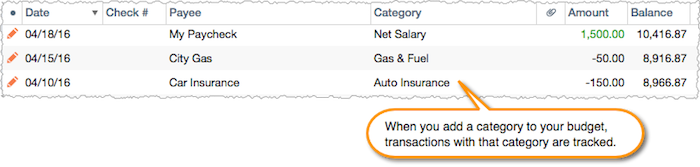
If a transaction impacting your budget has been miscategorized, you can change the category in your account register.
Special categories
Transfers are a special type of category because these transactions can cancel each other out if they appear in two different accounts. For example, if you transfer $50 from your checking account to your savings account, the transaction appears as an expense of -$50 in your checking account and an income of +$50 in your savings account. Adding both transactions together calculates to $0 in your budget, which doesn't help you when you're budgeting. For transfers you want to budget, we recommend using a linked transfer where you select the account the money is being transferred to. This way, when you select the category to budget, you can also select the specific account and the side of the transfer you want to budget, whether it's money leaving an account or going to an account.
A few "special" categories that cannot be added to a budget:
-
Adjustment
-
Transfer
-
Transfer: Credit Card Payment (or any subcategory under the Transfer category)
Budget rollover
Budget rollover carries a category's unused or overspent balance into the following month, so your effective budget adjusts automatically based on how the previous month went.
Enable rollover for a category
Hover over a category row and click the Rollover options button that appears. Choose one of the following:
-
Rollover balances at the end of every month: Carries over both positive and negative balances.
-
Rollover only positive balances: Carries over unused budget, but ignores overspending.
-
Rollover only negative balances: Carries over overspending, but ignores unused budget. This option is available only in Quicken Classic for Mac. Quicken Classic for Windows does not offer it.
Once selected, the row shows a small icon identifying its rollover mode, so you can see which categories have rollover enabled without opening the menu.
Turn off rollover for a category
Hover over the category row, click the rollover icon, and select Don't rollover.
Reading a category with rollover enabled
Each month shows two stacked numbers: a bold amount showing what you actually spent or received, and a lighter amount below it showing your effective budgeted amount for that month. Unlike a category without rollover, where the budgeted amount stays constant every month, this lighter number reflects the prior month's rolled-over balance and changes over time. It can become negative if enough of a balance has rolled forward.
Rollover for income categories
Rollover on an income category works in the opposite direction from an expense category. Earning more than budgeted reduces how much you need to earn the following month, rather than adding to it. If the effective budgeted amount reaches zero or goes negative, you have already met or exceeded that month's income goal before the month starts.
Rollover recalculates automatically whenever spending, income, or a budgeted amount changes.